FemiCore Ingredients Explained: What's Really Inside the Formula
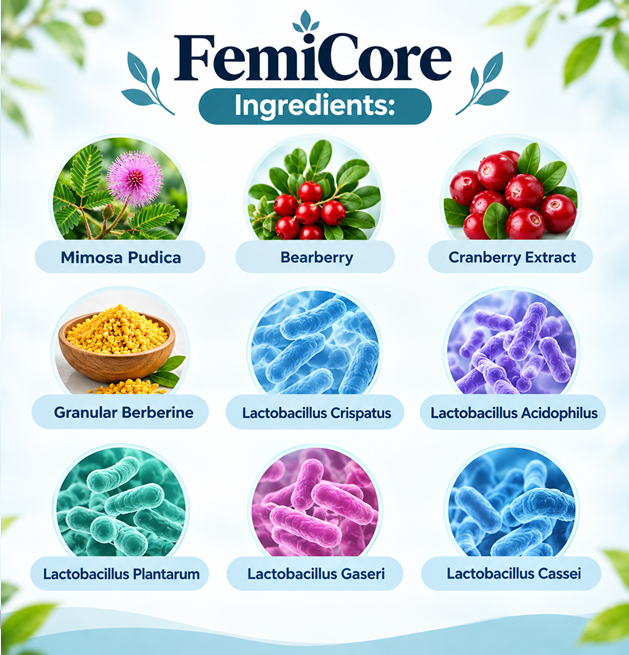
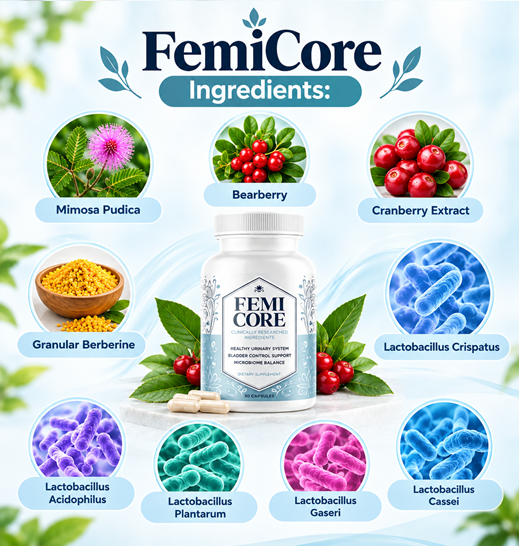
FemiCore is built around nine ingredients working together — four botanical extracts and five Lactobacillus probiotic strains. Here's a closer look at what each one is, why it was chosen, and what the research says about its role in urinary and bladder health.
60-Day Money-Back Guarantee
The Two-Part Formula: Botanicals + Probiotics
FemiCore's approach is built on a simple idea: bladder comfort depends on more than one system. So instead of relying on a single herb or a single strain, the formula combines two complementary groups of ingredients — botanical extracts that soothe and support the urinary environment, and a five-strain probiotic blend that works to rebalance the urinary microbiome from within.
The Botanical Blend
Mimosa Pudica
Mimosa Pudica is a seed extract known for its gentle binding properties. In FemiCore, it's included to help bind unwanted irritants circulating in the digestive and urinary environment, supporting cleaner internal conditions for the microbiome to rebalance naturally.
Bearberry (Uva Ursi)
Bearberry leaf has been used traditionally for centuries to support urinary comfort. Its main active compound, arbutin, has been studied for its role in traditional lower urinary tract support. In FemiCore, bearberry is included to help soothe sensitive bladder tissue during periods of irritation or urgency.
Reference: NIH Bookshelf — Uva Ursi (NBK556475)
Cranberry Extract
Cranberry is one of the most studied botanicals for urinary tract support, largely due to its proanthocyanidins (PACs) — compounds shown to help discourage bacteria from adhering to the bladder wall. A 2023 Cochrane review of 50 randomized controlled trials found cranberry products reduced UTI risk in women with a history of recurrent infection.
Reference: Cochrane Database of Systematic Reviews, PMID 37068952
Granular Berberine
Berberine is a plant-derived compound studied for its ability to interact with and help modulate microbial populations. In FemiCore, it's included to support a favorable balance of bacteria in the urinary environment — a foundation for steadier bladder signaling.
Reference: Frontiers in Nutrition, PMID 37599699
The 5-Strain Probiotic Blend
Lactobacillus Crispatus
Considered the cornerstone strain of the formula. Research consistently identifies L. Crispatus as the dominant, protective species in a healthy female urogenital microbiome, associated with more stable urinary balance.
Reference: The FEBS Journal, PMID 39080993
Lactobacillus Acidophilus
One of the most well-researched probiotic strains overall. A 2025 randomized, placebo-controlled trial found daily L. Acidophilus supplementation significantly reduced UTI incidence during the postpartum period — a life stage when many women first notice bladder changes.
Reference: Probiotics and Antimicrobial Proteins, PMID 40864416
Lactobacillus Plantarum
Known for surviving harsh digestive conditions to reach its intended destination intact. Included to help regulate localized inflammation and contribute to a more predictable bladder response over time.
Lactobacillus Gasseri
Particularly relevant for women navigating bladder changes tied to aging, hormonal shifts, or childbirth. Included to support urinary microbiome stability during these transitional periods.
Lactobacillus Casei
Strengthens overall microbiome resilience and supports long-term bacterial diversity — helping guard against the kind of recurring imbalance that contributes to ongoing bladder discomfort.
How the Two Groups Work Together
| Ingredient Group | Primary Role | What It Targets |
|---|---|---|
| Botanicals (Mimosa Pudica, Bearberry, Cranberry, Berberine) | Soothe & support the urinary environment | Tissue irritation, bacterial adhesion, microbial balance |
| Probiotics (5 Lactobacillus strains) | Rebuild beneficial bacteria | Urinary microbiome composition & long-term stability |
The idea behind pairing these two groups is that soothing the urinary environment alone doesn't address the underlying bacterial balance — and rebuilding the microbiome alone doesn't calm tissue that's already irritated. FemiCore is formulated to address both at once.
What's Not in FemiCore
- No stimulants or caffeine
- No synthetic hormones
- No GMO ingredients
- No artificial colors or fillers beyond standard capsule components
Try the Full Formula: Choose Your Package
2 Bottles
(60-Day Supply)
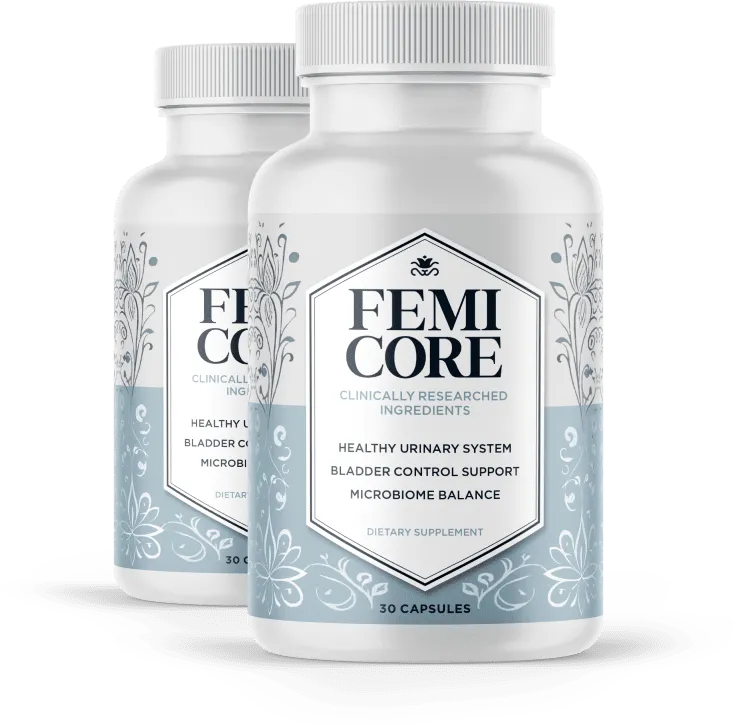
Regular: $99/bottle
$79/bottle
Total: $158 + $9.99 shipping
- ✓ 60-Day Money-Back Guarantee
- ✓ Secure one-time payment
3 Bottles
(90-Day Supply)
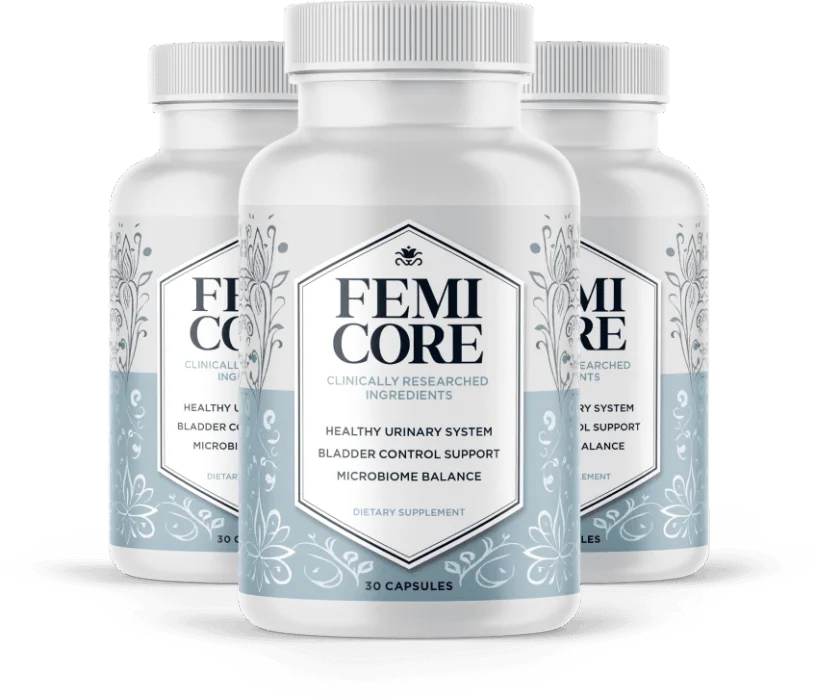
Regular: $99/bottle
$69/bottle
Total: $207
Save $40/bottle · Free Shipping
- ✓ 60-Day Money-Back Guarantee
- ✓ Free shipping & handling
6 Bottles
(180-Day Supply)

Regular: $99/bottle
$49/bottle
Total: $294
Save $50/bottle · Free Shipping + 3 Bonuses
- ✓ 60-Day Money-Back Guarantee
- ✓ Free shipping & handling
- ✓ 3 digital bonus guides
- ✓ Priority support access
Every package is protected by the 60-day money-back guarantee.
Ingredients FAQ
Is FemiCore vegetarian/vegan-friendly?
Yes, the formula is plant-based.
Does FemiCore contain common allergens?
FemiCore is formulated to be free of common allergens, but always check the label and consult your doctor if you have specific allergies or sensitivities.
Why are there 5 different probiotic strains instead of just one?
Different Lactobacillus strains play different roles — some are dominant colonizers (like L. Crispatus), others support diversity or survive digestive transit better. Combining several strains is intended to build broader, more resilient microbiome support than a single-strain product.
Is the cranberry extract the same as cranberry juice?
No — FemiCore uses a standardized cranberry extract concentrated for proanthocyanidins (PACs), rather than juice, which typically contains added sugar and a much lower concentration of active compounds.
Where can I see real customer feedback on results?
Visit the FemiCore Reviews page for a full breakdown of what customers report.